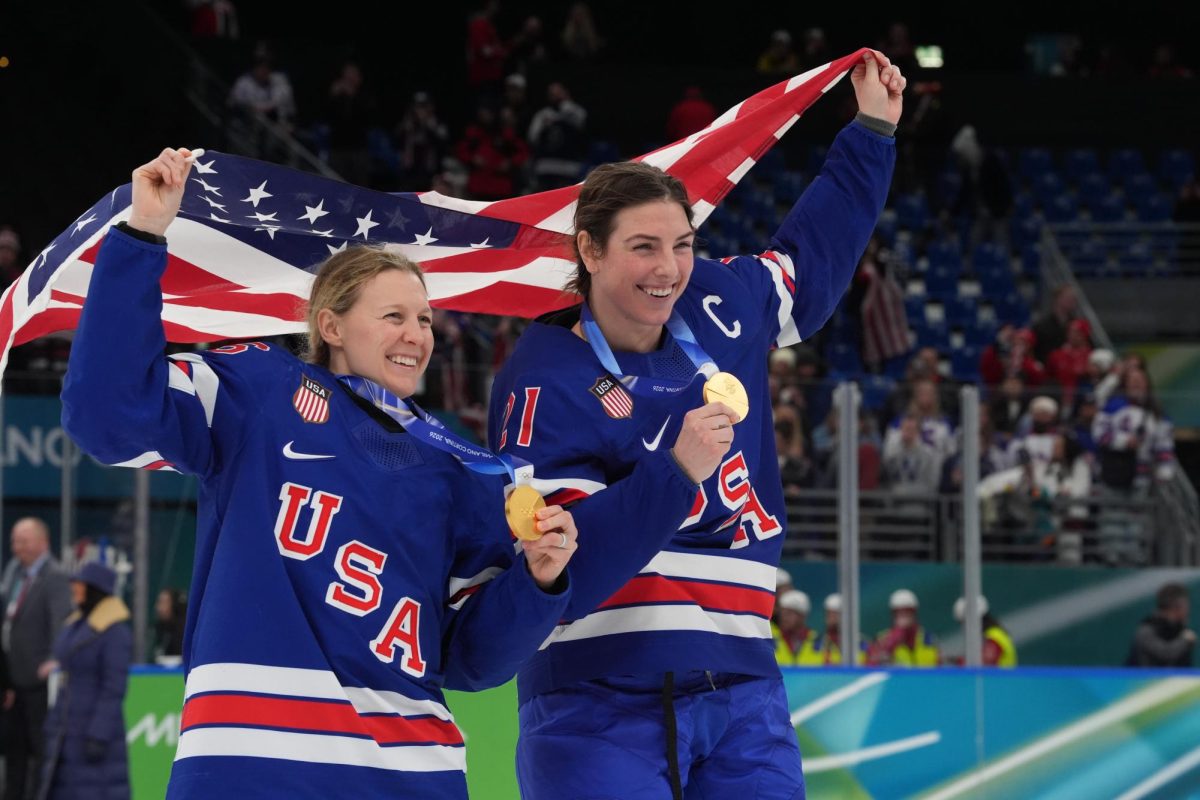


Scoring a total of 33 medals and placing second overall in country rankings, the U.S. athletes had lots of success during the Milan-Cortina 2026 Winter Olympics. But it was not only athletics that grabbed media attention, as the games prompted multiple political discussions during events in Milan.
Ukrainian athlete Vladyslav Heraskevych, for example, got disqualified from competing in the Men’s Skeleton event because of his insistence on wearing a helmet detailing the faces of Ukrainian athletes killed in the ongoing war with Russia. After refusing to wear the alternative black armband provided by the International Olympic Committee (IOC), Heraskevych was forced to watch his event compete without him.
“It’s definitely censorship,” junior Drew Rosenberg said. “The Olympics are supposed to be a free stage, and political expression should be able to be shown.”
The IOC stated that athletes are allowed to make political statements but that they should stay outside of the “field of competition.” This included the race in which Heraskevych’s helmet would have been worn.
“All they were doing was honoring athletes who died in a war,” freshman Ella Amiri said. “Wearing the helmet was a way to show respect for all of the lives lost and it therefore seems wrong to punish someone for that. I understand that there are strict rules about political messages being involved at the Olympics, but the athlete wasn’t trying to start a political fight or offend anyone.”
When athletes attend the Olympics, they represent their country, their flags and their performance. However, many athletes struggle to gain a strong sense of pride in their country as a result of the government’s actions.
“These athletes train for years, representing their country, so an athlete celebrating that they succeeded makes sense because they should be proud of where they’re from,” Amiri said. “Celebrating a country and being proud of yourself doesn’t mean you automatically agree with all their laws and policies.”
Specifically, over 12 athletes competed under a teal flag bearing, “Athlètes Individuels Neutres,” or Individual Neutral Athletes (AIN). This flag was given to athletes representing Russia and Belarus after the suspension of the Russian Olympic Committee in 2023, following the invasion of Ukraine. For the athletes themselves, they are prohibited from demonstrating support for the war or any affiliation with the Russian military, along with banned flags and anthems.
“It’s hard not to be able to represent your country and it’s hard that you have to face the consequences of the actions of your country, even if they were already preexisting,” junior Addison Huggins said.
However, for athletes representing countries not banned from the Olympics, some athletes question whether or not they should truly celebrate their country. While events in Milan were going well, dangers were still being posed to citizens back home. In the U.S., aggressive action by Immigration Customs and Enforcement (ICE) has led to at least eight fatal shootings and numerous woundings since January 2025. These actions have led to country-wide protests to abolish ICE, including one held at Walter Johnson on Jan. 23.
In addition, the U.S. men’s ice hockey team attended the State of the Union Address after a personal invitation by President Trump, after beating Canada in the finals to win the gold medal.
“It’s something you don’t get to do (every) Tuesday. It’s going to be special for us,” U.S. player Quinn Hughes said on the State of the Union invite (courtesy New York Times).
These actions have led some people to question the extent to which athletes should express pride in their country before it becomes ignorant of real issues posed by the government’s behavior.
“I think it’s one thing to go home and celebrate with your country; all the major sports championships go to the White House every year,” Rosenberg said. “This time it’s different, I don’t think I’ve ever seen a team go to the State of the Union Address.”
Overall, the political state of the world definitely had an impact on the games, but whether or not politics and huge sporting events go together is still hotly debated.
“Sports are supposed to be fun, not something that divides people because of their political beliefs,” Amiri said. “If politics get involved, it takes the fun away from the sport and ruins the purpose of the game.”