Antisemitism around MCPS has continued to surface in new ways. The language may shift, and the settings may change, but the underlying message does not: Jews don’t belong. At WJ and across MCPS, the question is no longer whether antisemitism exists, but why, for so many Jewish students and families, it must recur before it is taken seriously.
For Jewish students, this isn’t an abstract policy issue or a line item in a board meeting agenda. It’s the knot in your stomach when you walk into school, unsure of what might be written on a bathroom wall or etched into a desk. It’s the quiet calculation of whether wearing a Star of David will make you a target, or whether it feels safer to tuck it beneath a shirt.
Each incident is framed as an isolated act: one drawing, one comment, one photo. But stitched together across MCPS schools, these moments tell a larger story of repetition, normalization and exhaustion. Even after graffiti is removed and statements are issued, the message lingers, and for Jewish students, so does the feeling.
Antisemitism in Maryland has become increasingly visible in recent years, particularly in Montgomery County. According to the Anti-Defamation League’s 2024 Audit of Antisemitic Incidents, released in spring 2025, Maryland ranked fifth nationally for antisemitic incidents on a per-capita scale, with 5.68 incidents per 100,000 residents. Acts of antisemitic vandalism increased by 24 percent, while reported assaults rose by 40%.
Montgomery County accounted for approximately 55% of all antisemitic incidents statewide, highlighting its disproportionate impact. Within K-12 public schools, the concentration was even more severe: roughly 90 percent of Maryland’s reported school-based incidents occurred in Montgomery County, placing MCPS at the center of the state’s educational antisemitism concerns.
“Freshman year in my English class, someone threw pennies at my friend and I and asked if we owned a bank because we are Jewish,” junior Noa Zelermyer said. “When we spoke up, he yelled, ‘W Hamas. ‘ It showed me how antisemitism still exists at school and that it’s something that needs to be taken very seriously.”
These numbers are certainly alarming, yet they are not entirely new. Antisemitic harassment and vandalism have persisted around the Walter Johnson community for decades. Historical accounts indicate that Jewish students in the mid-20th century encountered slurs, exclusion and graffiti in their schools and neighborhoods.
Joan E. Biren (JEB), a Jewish American photographer, filmmaker and activist, graduated from Walter Johnson in __. In the Voices of Feminism Oral History Project, conducted by Smith College student Kelly Anderson, Biren recounts the antisemitic harassment and graffiti she experienced growing up in the Walter Johnson community, including defacing of her student government campaign posters with slurs and symbols.
Biren’s story is not just a distant memory from another era; it’s an early chapter in a pattern that has continued to surface around our community. Decades after her posters were graffitied with antisemitic slurs, the same symbols and messages are still appearing in local schools and neighborhoods.
One of the sharpest reminders came in 2023 at Tilden Middle School, a feeder school for Walter Johnson, when a social studies teacher was placed on administrative leave after social media posts she made went viral for being widely regarded as antisemitic.
In the posts, the teacher shared claims denying widely reported facts about the October 7 attack in Israel and made statements about Palestinians that many in the community found deeply hurtful and offensive. Tilden’s Principal later wrote to families, acknowledging that the incident “undermined our school’s values of respect and belonging” and that discrimination of any kind would not be tolerated.
“When I was in middle school, I had an antisemitic teacher who would call me out in front of the class to make me explain something about being Jewish or refer to stereotypes that weren’t true,” Jewish Student Union member, sophomore Jamie Silberglied said. “It made me upset because it made me feel like she looked at me differently than her other students.”
Silberglied’s experience did not involve the same teacher or circumstances as the Tilden case; it echoed similar concerns about antisemitic attitudes.
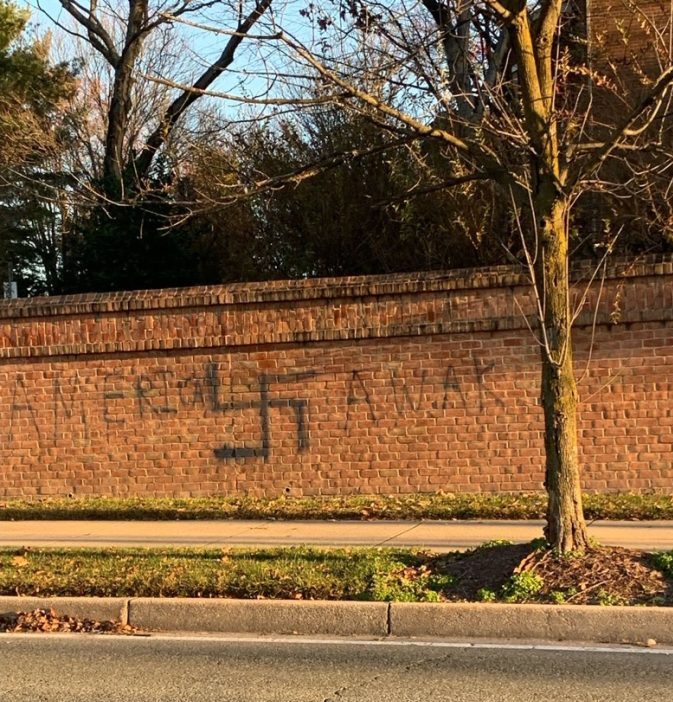
Anti-semitism continued to surface within the WJ community when antisemitic graffiti was discovered in multiple locations near campus in 2023. The vandalism included swastikas and explicit hate messages targeting Jewish people, some of which were found along public walkways and trails frequently used by Walter Johnson students.
What allows antisemitism to persist is not just hatred, but silence. When schools respond only to the incidents that are impossible to ignore, the smaller ones are given space to grow. At WJ, the absence of headlines does not mean there is no harm. Until every act, no matter how subtle, is treated as a warning rather than an inconvenience, antisemitism will continue to exist, not as a relic of the past, but as a presence that still floods our halls.