
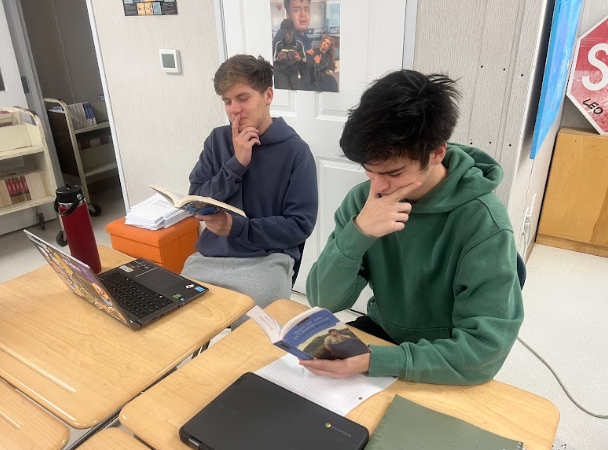
Required readings are an integral part of students’ academic coursework, starting as early as elementary school. A lot of the time, students find these readings boring or struggle to get through them. With these books taking weeks to cover in class, students have formed opinions, good and bad, on each one.
For some students, their favorite required readings are the books they most recently read in class. Frequently, these readings replace students’ previously favored novels.
“My favorite was Cormac McCarthy, ‘All The Pretty Horses’. I liked the plot and the theme of coming of age,” senior Grant Levens said. “You can feel the progression throughout the book, and I felt like it was a lot better than some other books I’ve read.”
Others’ favorite novels come by surprise. Despite not being what students initially expected, exploring the book, discussing the details and their overall connection to the book, leaves students with a greater understanding and love for the novel.
“I usually don’t like nonfiction books, but I really liked ‘Night’, which we read last year,” sophomore Arpita Vijay said. “I thought it was interesting because it was very detailed, and I never felt bored throughout it.”
Teachers have favorite required readings as well. Having repeatedly read and analyzed many books over the years, a favorite must excite them every time it’s time to read again.
“[My favorite is] ‘Beloved’, by Toni Morrison,” English teacher Aishling McGinty said. “The layers of the book and the exploration of the topic [are why it is my favorite].”
While detailed writing, interesting layers and intriguing progression may make a book become a student’s or teacher’s favorite, the same reasons can also make a book drop to the bottom of someone’s list.
When books are lost in old wording and metaphors, they can become confusing for many students to read. Having to put extra effort towards understanding a book you didn’t personally choose to read quickly leads to disinterest.
“[My least favorite was] ‘Dubliners’ for me personally. I just felt it was pretty confusing to read,” Levens said.
Every student has different tastes, and while some genres are highly popular, for others, not so much. For Vijay, she isn’t as interested in some of the commonly popular genres, such as fantasy.
“I wasn’t very interested in ‘Circe’. It was a fantasy book, and personally, I’m not as interested in fantasy, but I could see how some of the concepts from the book could be interesting to others,” Vijay said.
Having read and taught so many books, memorizing their messages, teachers find that many popular books can become less exciting. For McGinty, some of these mainstream novels are valued too highly.
“[My least favorite is] ‘Catcher in the Rye’ because I just feel that it is overrated,” McGinty said.
Students having less interest in some of the books read over others does not erase the fact that many students still enjoy reading. Most students’ interest simply depends on the book. Many students prefer reading different genres of literature that would interest them more.
“[I would like to read more] mystery books, I feel like we usually focus on either non-fiction books or fantasy and mythology books. I haven’t read anything in school related to more of a mystery,” Vijay said.
And while the books read in English courses are meant to help evolve our understanding of writing techniques and messaging in pieces of literature, fun reads that share themes of adventure or explore science fiction are often enjoyed by students.
“[I’d like] more fictional books instead of the ones that are all these crazy messages and everything,” Levens said.
Sometimes the novels we read in class aren’t what everyone wants to read or teach, and something of a different medium can bring more variety and interest to an English course. As with graphic novels, students’ interests in books depend on the genre and overall story rather than the category.
“I think graphic novels are underrated, and I’d love to teach a whole class on graphic novels,” McGinty said.