

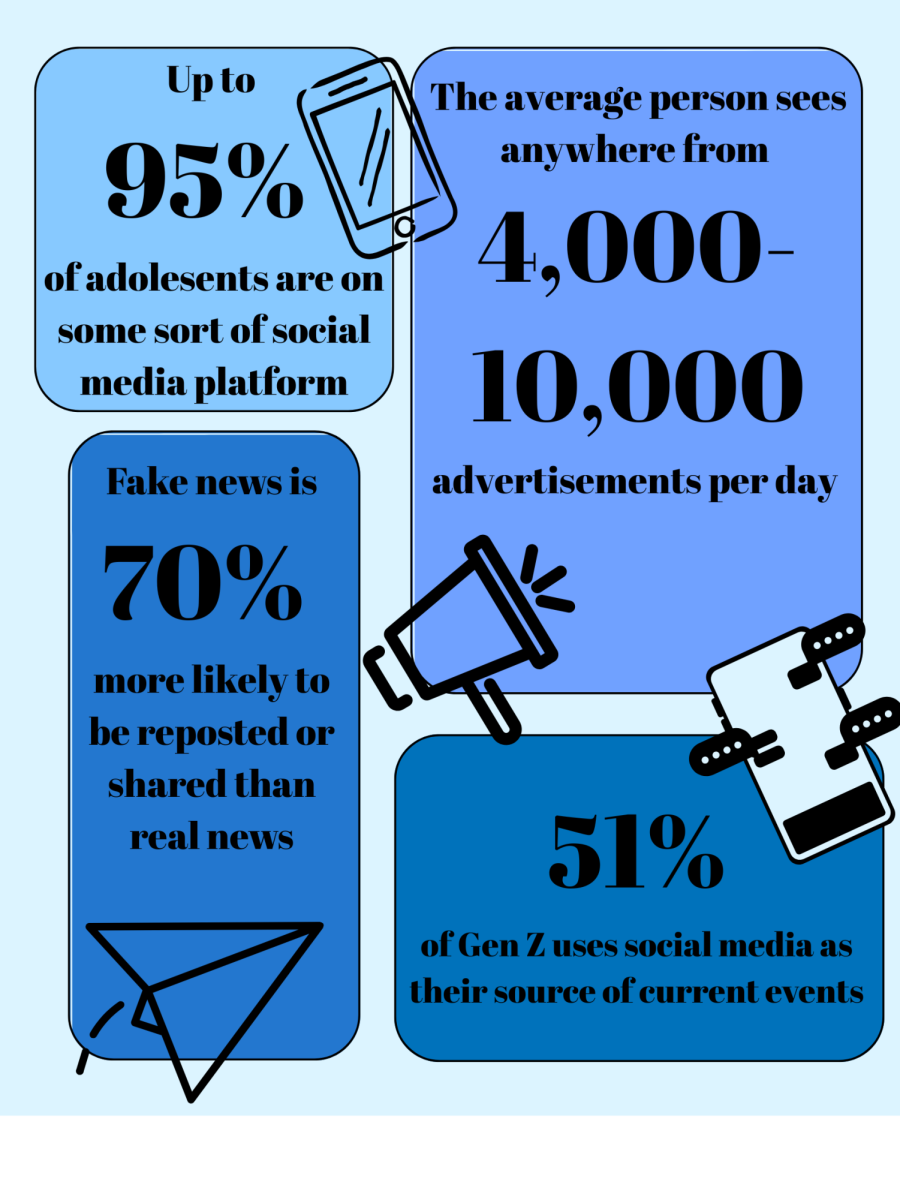
How often do you find yourself on social media, scrolling mindlessly through posts you forget about moments later? From TikTok to Instagram, Snapchat to X, no matter the social media platform, users are a prime target for misinformation. According to the Worcester Polytechnic Institute, the source of information for around 51% of Generation Z is social media. However, personalized algorithms ensure that users will never see a full picture.
Through tailoring the content fed to each user, adaptive algorithms are what social media platforms use to keep their users engaged. Through analyzing its audience’s likes, reposts and overall interactions, these platforms compel its users to be uneducated on current events by concealing different viewpoints. As addictive as these sights are, it is important to note that their main priority is profit.
“Technology and social media is based off of algorithms [that] are going to prioritize engagement over fact,” sociology and AP Psychology teacher Nicole McCarn said. “That then tends to normalize things that aren’t necessarily truthful.”
Confirmation bias is the tendency humans have to actively seek out or process information that conforms with existing beliefs or values. Social media takes this phenomenon and amplifies it. Since users are only exposed to information that confirms their ideas, their beliefs become much more extreme and polarized. The more frequently people are exposed to something, the more true and prevalent it seems.
“People tend to focus on perspectives that they believe in, and they look at those more polarized media sources, which means they tend to not see the other side of things,” AP and NSL Government teacher Kurt Sanger said.
The human brain is not done developing until the age of 25. This means that it is harder for students to recognize real vs fake news. The prefrontal cortex of the brain is responsible for decision-making, impulse control and overall executive functioning. Since the prefrontal cortex is still underdeveloped in teenagers, students are more likely to rely on their emotional responses, leaving them vulnerable to misinformation.
“The adolescent brain is still growing and developing critical thinking skills; it is already at a bit of a disadvantage and has more difficulty evaluating the credibility of a source,” McCarn said.
Although misinformation can be found in nearly every aspect of our society, social media serves as a breeding ground for fake news. Information is shared significantly faster on social media than by word of mouth. Whether from posts, comments, stories or messages, media is spread constantly and everywhere. This creates a vicious cycle of misinformation: a piece of information is misconstrued, shared, and the cycle repeats itself.
“You have to figure out if the source you’re getting is reliable… I don’t think people always know [if something is true] because if it’s someone they trust or seem to be popular, they’ll just believe them,” sophomore Talya Kachlon said.
This issue is fairly new, which means that there is not yet a concrete solution. It is up to the new generation and the students of WJ to learn how to navigate it. Some actions to keep in mind are fact-checking news, checking for reliable and objective authors and challenging biases.
“I encourage my students to read something they don’t like every day…,” Sanger said. “Sometimes it feels like they’re reporting on different worlds that we actually live in, so we have to be very conscious that there are biased perspectives.”